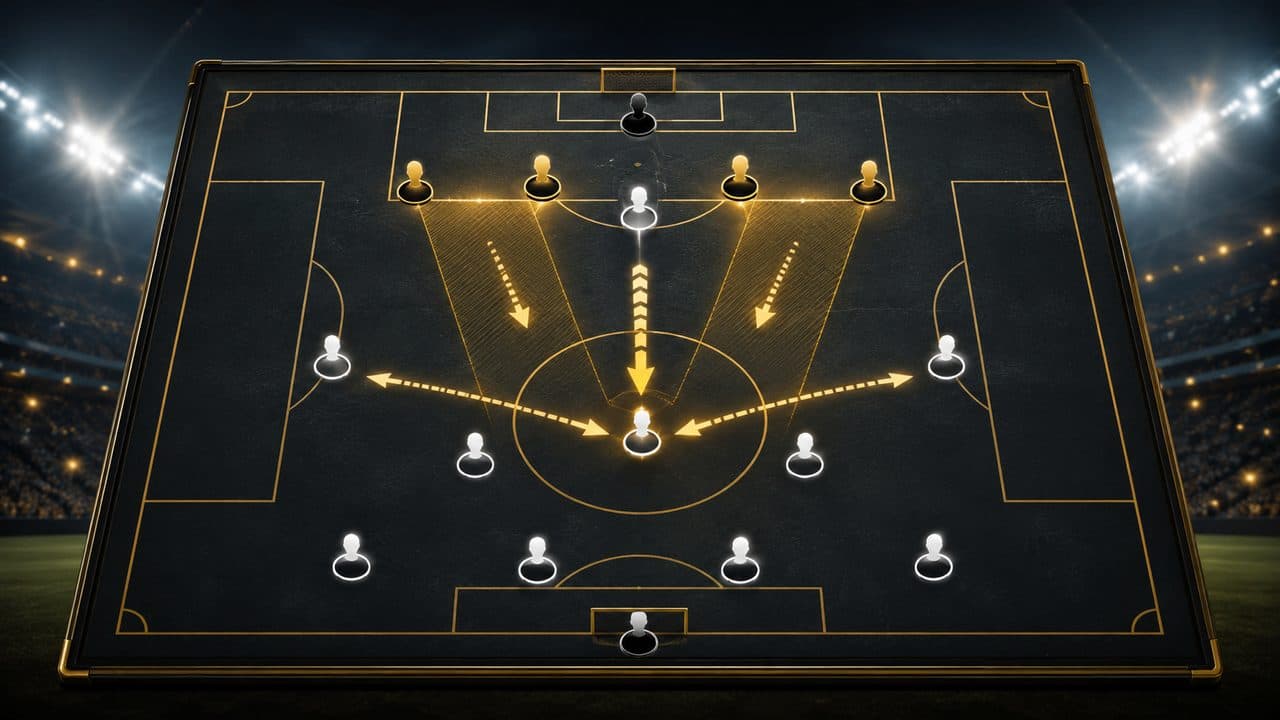
What is a false nine in football?
A false nine is an atypical centre-forward: instead of staying high like a classic "9", they drop into midfield to receive the ball. By doing so, they force the opposing centre-backs into an awkward choice: follow them (and leave a gap behind) or let them be (and let them receive between the lines).
Why it works
| Effect | Result |
|---|---|
| Drags the centre-backs out | Opens space behind the defense |
| Overload in midfield | Adds a man to the build-up |
| Defensive confusion | The opponent doesn't know who should mark them |
| Runs from deep | Other players exploit the space left behind |

¿Te gustó este artículo?
Pon a prueba lo que aprendiste con nuestra app oficial Football One Quiz.
Ver App GratisFamous examples
The most famous case is Lionel Messi as a false nine in Pep Guardiola's Barcelona, especially in the historic 2-6 win at Real Madrid in 2009. Before that, Francesco Totti had been used there in Spalletti's Roma and, much earlier, Nándor Hidegkuti in the great Hungary side of the 1950s.
Difference from a classic "9"
A traditional centre-forward plays with their back to goal, pins the centre-backs and finishes. The false nine prioritizes linking up, receiving between the lines and creating play, although they can score too.
Frequently asked questions
Who popularized the false nine in modern football? Pep Guardiola, using Lionel Messi at Barcelona.
Does a false nine score goals? Yes, but their main job is to create space and link up, not only to finish.
Which player is ideal for the role? One with good control, vision and link-up play, rather than a pure finisher.
Want to master football and the 2026 World Cup? Test your knowledge with Football One Quiz, the official app for iOS and Android.