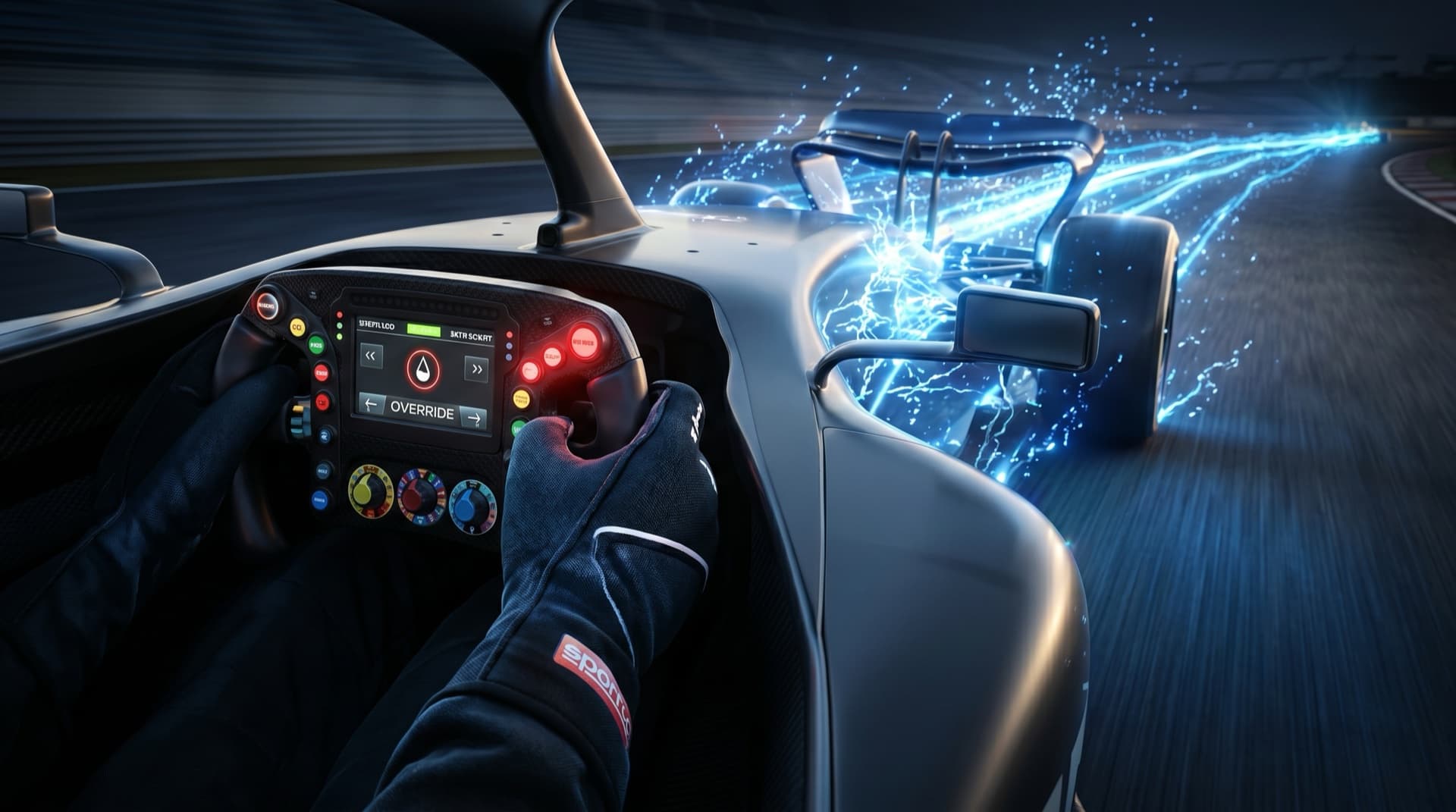
What is the override in Formula 1?
The override is the system that replaces DRS in the 2026 regulations. Instead of opening a rear wing to cut drag, the driver receives an extra electrical power boost when they are close to the car ahead.
How it works
- The attacker must be within one second of the car ahead at a detection point.
- By pressing a button, their MGU-K delivers extra electrical power for a limited stretch.
- The defender gets their normal energy allocation, without the extra boost.
- Available energy per lap is finite, so deciding when to spend it matters.

¿Te gustó este artículo?
Pon a prueba lo que aprendiste con nuestra app oficial Formula Trivia One Master.
Ver App GratisOverride vs DRS
| Aspect | DRS (until 2025) | Override (from 2026) |
|---|---|---|
| Mechanism | Movable rear wing | Extra electrical boost |
| Activation | Fixed DRS zones | Any straight |
| Defender | No counter | Same base energy quota |
| Management | Automatic in zone | Strategic energy spend |
Why it was introduced
The FIA wanted overtaking to depend on skill and strategy, not just driving into a zone and opening a flap. With the override both drivers have access to electrical energy, but the attacker can request a boost if they are close. Whoever manages energy better through the race will have more chances both to pass and to defend.
FAQ
How much extra power does the override deliver? The exact figure varies by race, but it is a meaningful share of the MGU-K's 350 kW.
Can it be used in qualifying? It does not work the same way; in qualifying every driver has free access to maximum power.
Is it the same as IndyCar's push-to-pass? The concept is similar, but it is integrated into F1's hybrid system.
Who decides when to activate it? The driver, based on the race situation and energy available.
Want to master F1 strategy and regulations? Test your knowledge with Formula One Trivia, the official app for iOS and Android.